All articles
Internal Comms Just Became a C-Suite Problem. Here's What the Data Says You Should Do About It.
Production quality inside the all-hands is the signal employees read as how much the organization values their time, and four in 10 will leave over it.
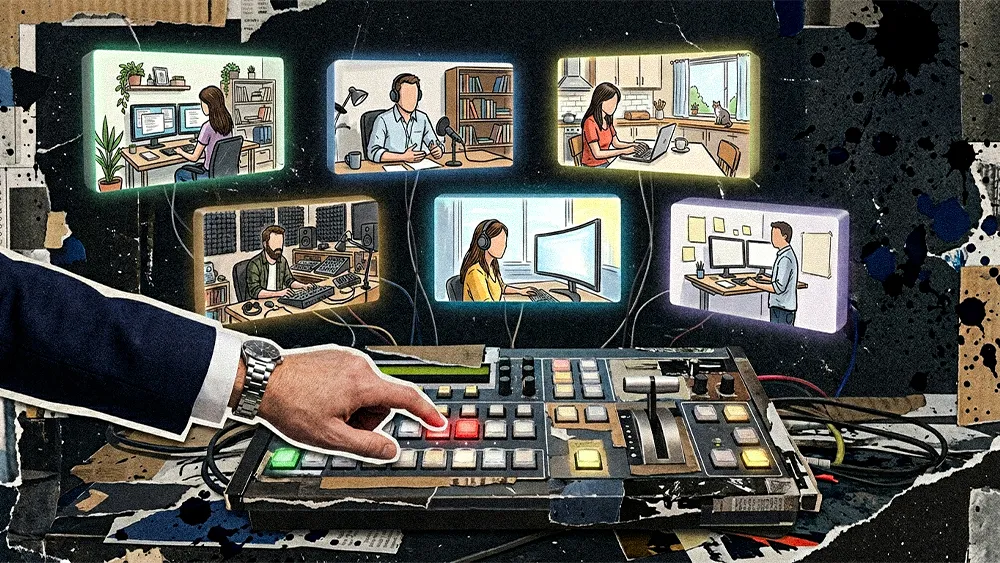

Internal communications, and the town hall specifically, have quietly become one of the most strategic pieces of infrastructure inside a large organization. What used to sit inside an HR function has moved into the same territory as brand work. The companies investing in it are pulling away from everyone still running the same slide-deck monologue they ran in 2015.
For decades, the corporate town hall was an afterthought. A CEO behind a podium. A deck no one remembered. A Q&A where the questions felt planted and the answers felt rehearsed. Employees endured them. Leaders tolerated them. Everyone went back to their desks, wondering why they had given up an hour of their day.
That era is finished. The companies leading the shift are treating internal communications with the same rigor, investment, and production value they once reserved for customers and shareholders. Employee experience has moved from a collection of fragmented initiatives to an integrated operating system, and the data has made the shift impossible to ignore.
The Retention Lever Hiding in the All-Hands
U.S. employee engagement fell to 31% in 2024, a decade low, according to Gallup, and the company estimates the cost of that disengagement at around $438 billion in lost productivity in a single year. Qualtrics' 2026 Employee Experience Trends report frames the underlying issue as a connection problem. Employees want to feel tied to their organization and what it stands for. The companies that cannot deliver that connection are the ones watching their best people walk.
The strongest communications operations have figured out that the town hall is where connection gets built or lost at scale. Salesforce research has found that employees who feel their voice is heard are 4.6 times more likely to perform at their best, and that finding maps almost exactly onto the mechanics of a well-run all-hands. The shift showing up across these operations is production. Broadcast-quality video, professional staging, multi-camera setups, and dedicated production teams have become standard equipment for events that used to run out of a single webcam.
Research from Vizrt found that nearly two-thirds of employees say receiving business updates through town halls and video content helps them understand those updates and feel aligned with company direction. Four in 10 say poor-quality video communications would make them consider leaving their job. Production quality has become a retention lever in its own right.
Internal Video Becomes Owned Media
The companies investing seriously in internal production are operating on a simple principle. If internal communications look and feel like an afterthought, employees will treat the message the same way. Wells Fargo is the clearest example of the shift. While much of the financial sector has been trimming internal investment, the bank has gone the other way, building an in-house video production team that now functions as strategic infrastructure across a workforce of more than 200,000. The team has enabled Wells Fargo to run town halls from any of its offices, showcase community investments at broadcast quality, and connect leaders and spokespersons to newsrooms at a level that used to require an outside agency.
The same pattern is showing up across industries, from retail operations trying to reach tens of thousands of frontline workers to tech companies building content operations around their weekly all-hands. The common thread is a recognition that internal video is owned media. It compounds the same way a well-run external newsletter or podcast does. An archive of thoughtfully produced all-hands content becomes an onboarding asset, a recruiting asset, a culture artifact, and part of the brand story that leaks outward through employees. Paid media does not deliver any of that.
The returns are more structural than statistical. Companies that invest in how they speak to their own people build an internal audience that shows up for them, advocates for them, and stays longer. Companies that do not end up paying for that attention twice, once to acquire it externally and again to replace the people who disengage and leave.
What a Serious Town Hall Operation Gets Right
My read on this, after watching the category evolve for a while, is that internal communications is now a brand function, whether the org chart reflects it yet or not. Employees are the audience, the town hall is a channel, and the production standard that travels through both is the thing shaping how people talk about the company when nobody from corporate is in the room. The operations getting this right are running against a consistent playbook.
Treat production as a first-class decision. The medium shapes whether the message lands. Employees can tell the difference between a hastily assembled video call and a thoughtfully produced broadcast, and they read that difference as a signal about how much the organization values their time.
Design the format for two-way engagement. The CEO monologue has aged poorly. The town halls that deliver built-in live Q&A, anonymous polling, and employee-submitted agenda items. Engagement deepens the moment employees help shape the dialogue.
Build the production function in-house. Wells Fargo and other leaders have made internal production a permanent part of the operation. Ownership keeps the team fast, authentic, and able to hold quality at scale without depending on an outside agency.
Measure beyond attendance. The strongest teams track real-time engagement rates, sentiment, drop-off points, and post-event comprehension. The town hall has become a data-rich feedback loop that tells leadership how the message actually landed.
Tie the work back to the story. Employees want more than updates. The town halls that land feature employee stories, community impact moments, and recognition that make the mission concrete.
The Gap Widens From Here
The workplace is in serious flux. Return-to-office mandates, AI-driven restructuring, and economic uncertainty are all forcing employees to reassess where they want to spend their time and whose story they want to be part of. Connection is the variable that determines whether employees stay, perform, and advocate for the company that signs their paycheck.
Town halls produced with intention, delivered with quality, and built for real interaction are one of the most concentrated tools a leadership team has for building that connection. The companies treating them that way are running internal communications as a brand function and a retention strategy at the same time.
I expect the gap to widen fast. Talent already knows the difference between an organization that invests in how it speaks to its own people and one that does not. Employees are watching, employees are deciding, and the companies that keep treating internal communications like a calendar obligation will spend the next decade wondering why their best people stopped listening.