All articles
Brand Clarity Becomes Competitive Edge as AI Scales Content Production
While AI can dramatically speed content creation, Beau Berman of PowerSchool explains that lasting brand trust still depends on human judgment guiding how that technology is used.

AI can get you past the blank page in seconds, but knowing what actually aligns with your brand and resonates with your audience still comes down to human judgment.

Beau Berman
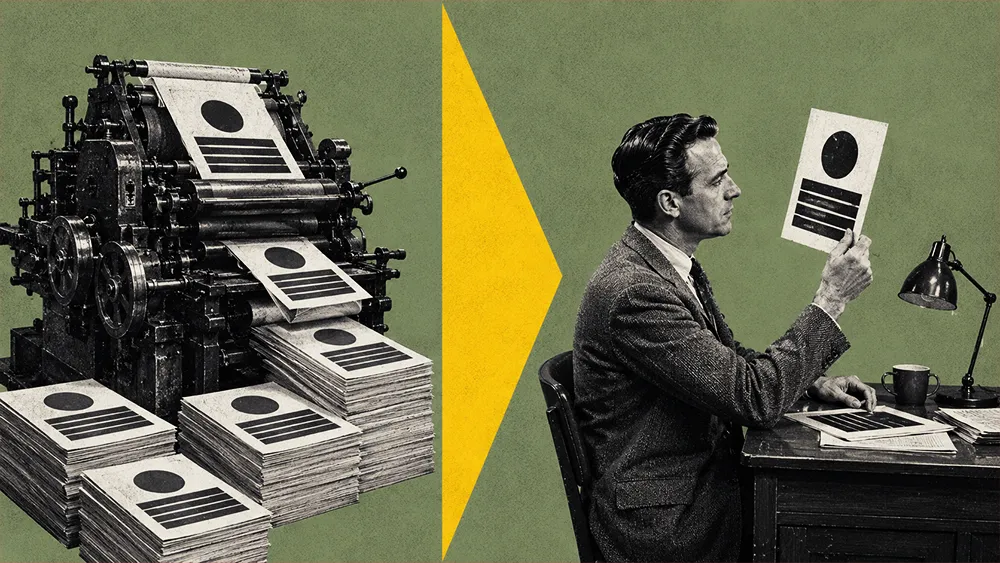
Generative AI has removed traditional production bottlenecks, but it has also made brand clarity and human judgment more important than ever. Low-effort AI content now triggers a collective eye-roll, as audiences grow skilled at spotting AI slop. Platforms like Pinterest are taking steps to limit unrefined AI content, signaling that discernment is the new baseline. This skepticism extends beyond public content. An obviously AI-generated profile photo or a cheap AI product shot, once a costly and painstaking effort, can now raise questions of trust or make a brand seem downright lazy.
We explored this reality with Beau Berman, Senior Communications Manager at the e-learning provider PowerSchool. An Emmy and Murrow award-winning former investigative reporter, Berman now focuses on public relations and crisis communications, including managing the largest data breach in K-12 edtech history. His experience gives him a unique perspective on the evolving value of creative work in the age of AI. "AI can get you past the blank page in seconds, but knowing what actually aligns with your brand and resonates with your audience still comes down to human judgment," he says.
Signal failure: Poorly executed AI outputs can feel off-brand, even if no one complains directly. As Berman notes, "No one might call you out verbally, but your customers will just feel it. They'll get a vibe that something is off. That’s a brand mismatch, like using a cyberpunk font for a lifestyle golf brand. Those two things just don’t make sense based on the history of your brand." Platforms are increasingly rewarding authentic human expression over mass-produced AI content, making alignment more critical than ever.
Human in the loop: Avoiding risks is only half the battle. The real opportunity is using AI as an additive force. AI can handle routine or time-consuming tasks, freeing creative teams to focus on higher-value work that requires judgment, intuition, and brand insight. The new ROI of AI is measured in the human creativity it unlocks. "AI is best used as an additive component. It should accelerate ideation and execution, but the authority still sits with the people who understand the brand, the audience, and what feels right."
Business realities often put brand principles to the test. He shares a common scenario: a CEO mandates the creation of 30 blog posts in three months to win with SEO. In that context, AI becomes a strategic tool, where established brand principles guide the compromise between speed and quality.
AI report card: Before evaluating AI-generated content, teams need a clearly defined brand identity to serve as a rubric for judgment. This internal compass allows outputs to be assessed for tone, style, and audience fit. Even when business realities require compromises, such as producing large volumes of content, brands should ensure execution aligns with core principles. As Berman explains: "Without a defined brand, you have nothing to be moored to when making these decisions. A compromise can be worth it as long as execution aligns with your principles. Brands should follow guardrails and understand the limitations."
Strategic tool use: Teams must weigh specialized platforms against general-purpose solutions and use judgment to decide what best supports their goals. This shift is redefining the value of creative professionals. "The work that AI can automate is shrinking, but the value of experience and judgment is growing. Clients now pay for expertise, not just technical skill."
Berman urges communication leaders to take control of the narrative rather than react to trends. That means being proactive, taking calculated risks, hiring experts, or securing enterprise licenses for powerful tools. "Take some chances, but with guardrails," Berman concludes. Enable your employees to unlock more creativity. The goal isn't just to be more productive, but to be more discerning, because that discernment is what will ultimately move the needle."